


07 / Sep / 2026
An honest guide after the 2026 floods
|
Our position: Autumn 2027 should remain a realistic season for Tsum Valley trekking, but no responsible operator can guarantee mountain-road or trail conditions this far in advance. Final operations should be based on the latest government notices, local field checks, weather, and route conditions. |
The floods and landslides of 2026 have understandably changed the way travellers look at trekking in northern Nepal. The concern is legitimate: roads and bridges were damaged, communities lost lives and property, and parts of the Manaslu access corridor were temporarily restricted.
At the same time, it is important not to treat a disaster in one part of Nepal as if the entire country has become inaccessible. Nepal is geographically diverse, and trekking conditions need to be assessed route by route. The same principle applies to Tsum Valley.
What happened in 2026?
On 26 August 2026, a major flood in the Bhote Koshi River in Rasuwa caused heavy loss of life and property. The Ministry of Home Affairs stated that the flood severely affected riverbank areas in Rasuwa, Nuwakot, Dhading and Gorkha, with rescue, relief and damage-assessment work continuing afterwards. [1]
Rasuwa is a neighbouring mountain district to Gorkha, but Tsum Valley itself is in Gorkha District. The distinction matters because the Rasuwa disaster should not automatically be interpreted as a blanket closure of Tsum Valley.
There was, however, a further development that trekkers should know about. Following flooding around the Budhi Gandaki and nearby rivers in northern Gorkha in early September 2026, the District Administration Office, Gorkha issued a public notice asking people not to undertake trekking until further notice. This is a current 2026 restriction, not a declaration that the autumn 2027 season is cancelled. [2]
Why autumn 2026 remains a realistic season
Nepal’s monsoon is the period when the country is most exposed to heavy rainfall, flooding and landslides. Nepal Tourism Board states that about 80% of Nepal’s annual rainfall occurs during the June-September monsoon and identifies October and November as the months with the clearest skies after the monsoon. The Board also describes spring and autumn as the best trekking seasons in Nepal. [3]
That seasonal pattern is one of the main reasons October and November continue to be the core trekking months across Nepal. The end of the monsoon does not make the mountains risk-free, but it generally removes the persistent heavy rainfall that creates the greatest monsoon-related pressure on trails, slopes and rivers.
1. The main issue may be access - not the existence of the valley
The 2026 disasters have highlighted an important reality of Himalayan travel: a trekking destination and the road used to reach it are not the same thing.
A trail may remain usable while its approach road is damaged. Conversely, a road may reopen while a particular bridge or trekking section still needs work. This is why route planning for Autum 2026 should remain flexible rather than being based on a fixed assumption made in early.
The Trekking Agencies’ Association of Nepal (TAAN) maintains trekking-sector information and has a long record of supporting the opening and reconstruction of community and trekking trails after disasters, including work in Rasuwa, Dhading and Gorkha after the 2015 earthquake. [4]
For a Tsum Valley trek, this means we should be prepared to use the safest available approach route rather than insisting on one road simply because it is the traditional route.
2. Nepal’s other trekking regions are not one single disaster zone
The 26 August flood was concentrated along the Bhote Koshi/Trishuli corridor and the Ministry of Home Affairs specifically identified Rasuwa, Nuwakot, Dhading and Gorkha among the affected districts. [1]
Major trekking destinations elsewhere in Nepal - including Everest, Annapurna, Kanchenjunga, Mustang and western Nepal - are geographically separate from that corridor. That does not mean every access road in every district is guaranteed to be open at any given moment; it means that travel decisions should be made according to the actual condition of each destination and its access route rather than a nationwide assumption.
Nepal Tourism Board continues to present the country as a multi-region trekking destination, while its official information identifies separate trekking regions and their respective access arrangements. [5]
3. What makes Tsum Valley different?
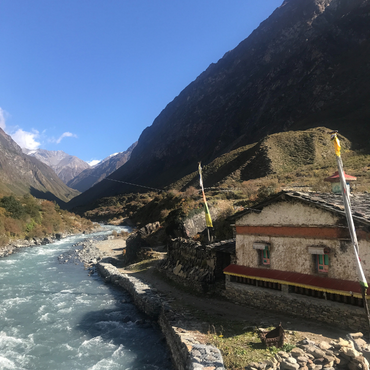
Tsum Valley is a remote Himalayan valley in northern Gorkha. It is also a controlled trekking area: Nepal Tourism Board notes that a special trekking permit is required for restricted areas, and the Department of Immigration lists the Tsum Valley area of Gorkha among the routes requiring such permits. [7][8]
That controlled system is one reason organised trekking is particularly useful here. Operators have to manage permits, designated routes and local logistics, and they are responsible for coordinating the trek rather than simply sending travellers into the mountains independently.
4. Our responsibility: safety first, not false certainty
We are not going to tell travellers that Tsum Valley will be “100% safe” in October or November 2026. No one can responsibly promise that in a Himalayan environment.
What we can promise is a process. Before operating a trek, we will assess the latest road and trail conditions, consult local communities and relevant authorities, consider weather and river conditions, and change the itinerary when a route is not appropriate.
Our guides and porters are deeply familiar with the Tsum and Manaslu area. Many have spent years, and in some cases decades, travelling these trails in different seasons. Their knowledge is practical: they know the villages, terrain, seasonal conditions and the realities of moving people and equipment through a remote Himalayan landscape.
Our trail leadership also includes high-altitude experience, including climbing experience on peaks such as Mera Peak, Ama Dablam and 6,000-metre-class mountains. More importantly, our operational focus is Tsum Valley and the Manaslu Circuit - the places we know and work in repeatedly.
5. Autumn(Oct-Nov): what trekkers should realistically expect?
The most realistic expectation is not “nothing will have changed.” It is “the route may have changed, and a responsible operator will adapt.”
By the September end, there may be repaired roads, rebuilt bridges, rerouted trail sections or improved access compared with the immediate post-flood period. There may also be temporary diversions.
The Department of Immigration currently lists September-November as the seasonal period for the Manaslu restricted-area permit and separately lists the Gorkha Tsum Valley route. This reinforces that autumn is an established operating season for the area, while the actual ability to operate on a particular date remains dependent on field conditions and official notices. [8]
So, should you trek Tsum Valley in autumn 2026?
Our answer is: yes, Tsum Valley remains a journey worth planning for autumn - with an understanding that the final route and operating decision must be made from current conditions, not assumptions.
The floods were serious and should not be minimised. Nepal’s mountains have always required respect, especially during and immediately after the monsoon. But the presence of a disaster in one season does not mean the following autumn is automatically unsafe.
For travellers, the best approach is to choose an experienced operator, allow some flexibility in the access itinerary, and confirm the latest road, trail and government situation before setting out.
|
The mountains will not be the same after a disaster - but they are still there. Tsum Valley is more than a trekking route. It is a living valley of communities, monasteries, culture and mountain landscapes. We hope to welcome trekkers back responsibly when the routes are ready.
|
Travel advisory
This article reflects information available as of 7 September 2026 and discusses the expected context for October and November. Conditions in the Himalayas can change quickly. Roads, bridges, trails, weather, local restrictions and government advisories should be rechecked before departure. Trek operation should proceed only when the selected route is considered appropriate by the operator and relevant authorities.
Sources and references
[1] Ministry of Home Affairs, Government of Nepal. “Official Disaster Relief Appeal” (26 August 2026). https://moha.gov.np/en/post/ha-ra-tha-ka-apa-l-11
[2] District Administration Office, Gorkha, Ministry of Home Affairs. Public trekking restriction notice following the September 2026 flooding. https://daogorkha.moha.gov.np/post/pathaya-ta-ra-nagara-na-nagara-una-sama-vana-thha-ata-yana-ta-jara-ra-sa-cana
[3] Nepal Tourism Board. “Climate” - monsoon rainfall and autumn trekking conditions. https://ntb.gov.np/plan-your-trip/about-nepal/climate
[4] Trekking Agencies’ Association of Nepal (TAAN). “Introduction” - disaster response and community trail reconstruction work. https://www.taan.org.np/page/introduction
[5] Nepal Tourism Board. Official trekking and destination information. https://ntb.gov.np/
[6] Nepal Tourism Board. “Langtang Region” / Tamang Heritage Trail information. https://trade.ntb.gov.np/tourist-destination/langtang-region/
[7] Nepal Tourism Board. “Trekking Permit” - restricted-area trekking requirements, including Tsum Valley. https://ntb.gov.np/en/plan-your-trip/before-you-come/trekking-permit
[8] Department of Immigration, Government of Nepal. “Trekking Route and Permit Fee” - current restricted-area routes and seasonal Manaslu/Tsum information. https://immigration.gov.np/trekking-route-and-permit-fee
[9] Trekking Agencies’ Association of Nepal (TAAN). “Trekking Permit Fees” - trekking area/permit information. https://www.taan.org.np/page/trekking-permit-fees
Editorial note
This article intentionally avoids stating that all of Nepal or all of Tsum Valley is “unaffected” by the disaster. It separates the Rasuwa disaster, the later Gorkha restriction, seasonal weather, and the practical question of route access so readers receive a realistic picture rather than a blanket assurance.
Address
House no: 70 / 16, Ga, Sainik Awaas Marga, Bijeswori-15
Kathmandu, Nepal

